

It was the winter of 1971. Or maybe it was 1972. I'm not clear on the date but I can tell you that as a boy of 10 or 11 years old the snow drifts seemed higher than they do now in middle age.
I was sitting inside the Jamestown, N.D., Senior High gym waiting for a basketball
game to begin. No, not the famous Blue Jays who went on to win three or four
Class A basketball titles in the 1970s. This game was being played by the stuff
of legend only before witnessed on the television console in my parents' living
room. The Minnesota Vikings had come to play off-season basketball in my hometown.
I was so excited that I wore my Viking stocking cap with the purple and yellow
tassel the whole day at school.
And when the Vikings came out they were bigger than any men I have ever seen before. I will always remember that exhibition basketball game. I will always remember having my Minnesota Viking pennant and poster signed and shaking the hands of Dave Osborn, Bill Brown, Wally Hilgenberg, Roy Winston, Carl Eller, Jim Marshall, Gary Larsen, and others. I taped the poster and pennant to my bedroom closet door as soon as I got home. And there they stayed they through the rest of grade school, junior and senior high. The taped yellowed and the autographs faded but the memory remains.
 Watching
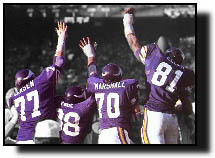
the Vikings play their real game on television was something like this. Picture
four colossal, powerful men dressed in purple football gear. They huddle together,
waiting for the next play and take a few deep breaths, the frosty mist visible
upon exhalation. Icicles have formed on their beards and mustaches. Seeing that
the offensive line is nearly ready, they split up to take their positions. Their
last words before they part are "Meet at the quarterback!"
Watching
the Vikings play their real game on television was something like this. Picture
four colossal, powerful men dressed in purple football gear. They huddle together,
waiting for the next play and take a few deep breaths, the frosty mist visible
upon exhalation. Icicles have formed on their beards and mustaches. Seeing that
the offensive line is nearly ready, they split up to take their positions. Their
last words before they part are "Meet at the quarterback!"
That's the way I remember those years. It was the defensive line of the Minnesota
Vikings that made famous the saying "Meet at the quarterback." More often than
not, at least two of the Vikings' linemen would do just that before the quarterback
had time to pass. If all four arrived at the same time, that was more fun yet.
I often imagined I was there with them. I would leap off the living room couch, arms raised high like Alan Page, fingers scrapping off ceiling plaster. My nemesis, the seat cushion from my mother's favorite chair, would be crushed by my maddening fury just as Marshall and Eller crushed a unlucky Sonny Jurgenson or Roman Gabriel on the television screen. The meeting, for both the actual quarterback and the seat cushion, was not much fun for either.
The Vikings' defensive line was so good in the late 1960s and during the 1970's that it obtained several nicknames. The "Purple People Eaters" and the "Purple Gang" were the ones most often heard. Like other good defenses, the Vikings tackled quarterbacks and runners for losses, but they went a step further. They used a "big play" defense that could turn a game from defeat into victory in one spectacular play. The Purple People Eaters did not consider it a day's work unless they intercepted passes, forced fumbles, blocked punts and field goals, and ran back loose balls for touchdowns. The defense was so good that even when the other team had the ball, it was difficult to say which team would score. Even if the opposing team had marched into the red zone, it was not uncommon to see Paul Krause or Bobby Bryant intercept a Page-tipped ball and run it back 70+ yards for a score.
The Purple People Eaters were not as monstrously big as our nemesis in those grade school days, the Rams' Fearsome Foursome. In fact, they were rather small compared to most defensive linemen, but they were incredibly fast. Many times a fleet runner would see a clear path to the end zone only to have a large hand grab and pull him down from behind. It wasn't unusual for a speedy Viking player on the left side of the line to make tackles on the right side of the field and visa-versa.
In those heady days of yore it was often left DE Carl Eller leading the charge. Eller started with the Vikings in 1964 after playing for the Minnesota Golden Gophers. His height, long arms, and leaping ability made throwing over him about as easy as throwing over a skyscraper. Standing 6 feet, 6 inches tall and weighing 246 pounds, he could take his choice of either tossing blockers aside or speeding past them. Eller became the defensive leader of the Vikings. Players would often meet at his house to talk football or just to relax. Packer quarterback Bart Starr, at the end of his career, called Eller the best defensive lineman in football. "He's all the great defensive ends rolled up into one," he said. Starr probably reached that conclusion after one game against the Vikings in 1968. In that game, Eller sacked Starr three times, caused him to fumble once, and blocked a crucial field goal attempt.
 Next
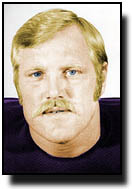
to Eller was the Norse Nightmare, Gary Larsen, at left DT. The blond, mustached,
big ex-marine actually seemed to derive joy from the punishment of the pit.
Larsen was not as fast as the rest of the front four, but he stood his ground
and caught nearly every runner that was foolish enough to wander into his area.
Next
to Eller was the Norse Nightmare, Gary Larsen, at left DT. The blond, mustached,
big ex-marine actually seemed to derive joy from the punishment of the pit.
Larsen was not as fast as the rest of the front four, but he stood his ground
and caught nearly every runner that was foolish enough to wander into his area.
The Vikings' team meetings at the quarterback began with the arrival of Alan Page in 1967 as the right DT. Before then, Bud Grant had never let a rookie start. Grant thought that new players should watch and learn from their elders. But Page's stellar play in training camp and preseason games made Grant change his mind. Page was too good to be a benchwarmer. While playing high school football in Canton, Ohio, Page was called "the best high school player I ever saw" by a college coach who was scouting him. Page's college days at Notre Dame made him an even better player. Page was so quick that he sometimes reached the runner before the hand-off did. He also made it a point to never let up on the play until it was over. When an opponent fumbled a ball, it usually became the personal property of Page. In 1970 alone, he recovered six loose balls.
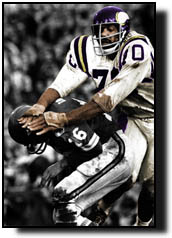
At right DE was Jim Marshall and he played the position for so long that he could probably do it in his sleep. By the end of the 1979 season, Marshall had played in 282 consecutive games in a row, more than any other player in NFL history. Though small for his position, Marshall had breakneck speed and was keen for getting into the backfield. His passion for speed often carried over off the field as well.
 Bill
Brown relayed a story to me at the Draft Party in 1997. The subject of training
camp had come up and Bill said that the ride down to Mankato could be an exceptionally
exciting one if you happened to find yourself sitting shotgun with Jim Marshall.
Seems Marshall had a penchant for driving fast and his car had a dashboard full
of every radar detector known to mankind. Brown remembered one such drive, speeding
along at 85 mph himself when he spied a fast moving car quickly approaching
him from behind. It was Marshall, going about 130 mph according to Brown.
Bill
Brown relayed a story to me at the Draft Party in 1997. The subject of training
camp had come up and Bill said that the ride down to Mankato could be an exceptionally
exciting one if you happened to find yourself sitting shotgun with Jim Marshall.
Seems Marshall had a penchant for driving fast and his car had a dashboard full
of every radar detector known to mankind. Brown remembered one such drive, speeding
along at 85 mph himself when he spied a fast moving car quickly approaching
him from behind. It was Marshall, going about 130 mph according to Brown.
Marshall always took back roads because Bud Grant would have had a fit if Marshall would have been caught. Another player, according to Brown, had purchased a Jaguar just to outrun Marshall. The player was picked up one night returning to the Twin Cities, the Jag alongside the road, both rear tires blown out, trying to keep up with Marshall, the unnamed player muttering to himself.
He loved everything about the game itself. Marshall's sheer joy in working with people and playing his favorite game rubbed off on his teammates. Players, coaches, and even the team owners marveled at how good it felt just to be around him.
 From
1968 and well into the 1970s, the Purple People Eaters humbled the best offenses
in pro football. After completing only 8 of 22 passes in a game, quarterback
Johnny Unitas of the then Baltimore Colts called the Vikings the best pass rushers
he had ever seen. In a 1969 game, quarterback Bart Starr found himself again
in serious trouble. During the game, Starr was upended eight times and the longest
play of the day was only 13 yards. The Purple People Eaters so rattled the Detroit
Lions one-day that the Lions committed 11 fumbles. In the famous playoff game
against the Rams in 1969, the Vikings' Carl Eller bowled over an all-pro blocker
to tackle the Rams' quarterback for a game-critical safety.
From
1968 and well into the 1970s, the Purple People Eaters humbled the best offenses
in pro football. After completing only 8 of 22 passes in a game, quarterback
Johnny Unitas of the then Baltimore Colts called the Vikings the best pass rushers
he had ever seen. In a 1969 game, quarterback Bart Starr found himself again
in serious trouble. During the game, Starr was upended eight times and the longest
play of the day was only 13 yards. The Purple People Eaters so rattled the Detroit
Lions one-day that the Lions committed 11 fumbles. In the famous playoff game
against the Rams in 1969, the Vikings' Carl Eller bowled over an all-pro blocker
to tackle the Rams' quarterback for a game-critical safety.
Nothing can match the Vikings' 1971 season however. That year, Eller won the Most Valuable Defensive Player award and Alan Page was voted the Most Valuable Player in the League, making him the first defensive player to have ever earned the honor. A series of plays in a game against Detroit showed what kind of game Page had that year. Incensed at himself for making two mistakes in a row, Page simply took charge of the game. On first down, he sacked the quarterback for huge loss. On second down, he dove over a blocker and caught the runner for another loss. On third down, he sacked the quarterback again for another loss despite the man blocking him being flagged for holding. On fourth down, he blocked the punt.
The Purple People Eaters earned a record four trips to the Super Bowl with Eller, Page, and Marshall starting in every one of them.
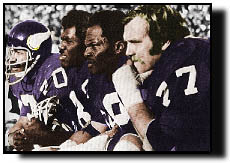 But
the Purple People Eaters didn't just participate in football, they had other
interests as well. Page pursued a career in law and eventually became a Minnesota
Supreme Court Justice. Eller turned to dramatic acting and performed in a film
called the Black Six. Marshall enjoyed practically anything, whether it was
reading poetry, parachuting, scuba diving, mountain climbing, skiing, or managing
a rock group. Others have had the fortune of winning Super Bowls, but none have
done what the Purple People Eaters have done. For more than ten years, since
1967, they played defense together as well as it could be played. They won their
division title every year they were together except for one. Long after other
players of their age had retired, been injured and replaced, the Purple People
Eaters were still pulling down runners and having team meetings at the quarterback.
But
the Purple People Eaters didn't just participate in football, they had other
interests as well. Page pursued a career in law and eventually became a Minnesota
Supreme Court Justice. Eller turned to dramatic acting and performed in a film
called the Black Six. Marshall enjoyed practically anything, whether it was
reading poetry, parachuting, scuba diving, mountain climbing, skiing, or managing
a rock group. Others have had the fortune of winning Super Bowls, but none have
done what the Purple People Eaters have done. For more than ten years, since
1967, they played defense together as well as it could be played. They won their
division title every year they were together except for one. Long after other
players of their age had retired, been injured and replaced, the Purple People
Eaters were still pulling down runners and having team meetings at the quarterback.
And on my boyhood bedroom closet in Jamestown, N.D., the outline of a very special poster and pennant can still be seen.
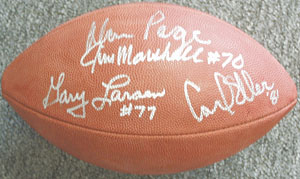
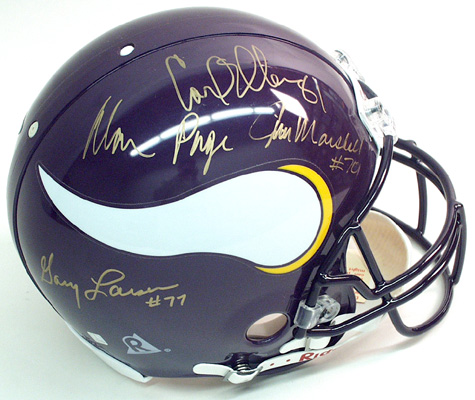
Purple People Eaters
Autographed Football
(Eller, Page, Larsen, Marshall)